They Lie We Die

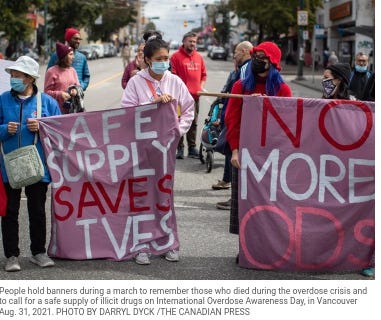
Pardon the ableism, but I feel like I’m taking crazy pills. Everyday a politician repeats an outright lie about harm reduction or safe supply. Everyday we pull our hair out rebutting them. All the while our friends are dying.
We probably don’t need another article about this, there are plenty out there from people more qualified than me, but I’ve seen close friends repeat some of these mistruths. No, we don’t have a safe supply of drugs in B.C. (only 2% of drug users access the prescribed alternatives program). No, drugs are not legal. No we don’t hand them out for free. No, harm reduction doesn’t enable addicts. No, it doesn’t prevent someone from getting in to treatment. No, overdose prevention sites don’t dispense drugs. No, there’s no heroin in the province (so stop comparing us to Portugal). No junkies aren’t dying en masse in the street (casual users are dying in their homes).
And yet why do politicians continually repeat these lies? We’ve known for a while that the alt-right shifted their gaze from Free Speech dogwhistles on University Campuses to people who use drugs. The treatment industry is an unregulated billion dollar a year industry and the far-right rabble- BC Proud, Safer Vancouver, and all those exploitative Youtubers like Aaron Gunn- are all working behind the seems to viciously attack harm reduction and safe supply and benefit treatment centres like Last Door.

Aside from the obvious grift of preying on peoples’ fears and the collusion with the treatment industry, and aside from the very real aim to make displacement palatable by painting our cities as dystopian hellholes, it comes down to the conservative impulse to reduce complex issues into absolutes, to turn policy failures into moral shortcomings, and most importantly- to control the bodies of those who fall outside of white supremacist ideal: women, homosexuals, immigrants, and now drug users.
It also comes down to the neoliberal project: decimate the social safety net, blame the issue on personal responsibility, demonise the poor, and lobby for more police. When crime goes down it worked, when it doesn’t- more police! On top of this, you have an army of bootlickers ready to punch down on those most affected by policy failures while ignoring the root causes- inequality bred by decades of austerity. Their Randian mantra of personal responsibility is really a psyop to deflect blame away from the system and onto those traumatized by the system.
And since we are at a confluence of not one but potentially 3 toxic elections, the pearl clutching has reached a fever pitch. The most recent as of this writing is foreign agent Adam Zivo’s bizarre and hilarious assertion that “B.C. wants to turn washroom’s into comfortable drug dens” which has been shared by countless Conservative MPs, MLAs, and candidates (the headline has since been corrected). Trouble is, it’s not a B.C. policy, it’s an initiative by Vancouver Coastal Health and, like much of what concerns these reactionary teacups, it’s meant to keep people alive- in this case, appealing to businesses that putting blue lights in washrooms to make it harder to find a vein does more harm than good.
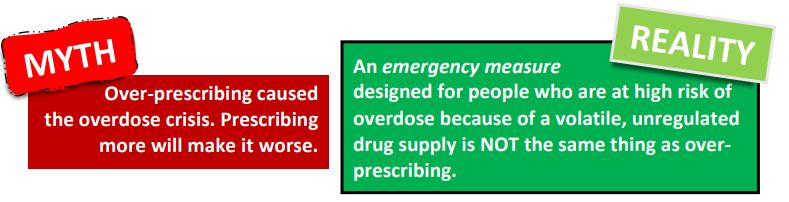
Before that, it was the righteous furore of NIMBY's who had discovered a vending machine of harm reduction supplies at a hospital. That’s right, health materials at a hospital… shocker. Outrage swept across the country leaving the NDP to once again back peddle. Having already caved to pressures around harm reduction and decriminalization, the NDP were more convinced by Karens complaining that tax dollars shouldn’t pay for crack pipes than the very real threat of a spike in Hep C and HIV (costing taxpayers magnitudes more). Dave Eby also caved to conservative pressure on a supportive housing project in Richmond (and the carbon tax), lending him the nickname Cave Easy.
Their logic goes: seeing a mouthpiece in a vending machine will enable drug users, or children, to become addicted. Of course, there’s absolutely no proof that harm reduction supplies enable drug users any more than giving free condoms in schools enables teenagers to have sex. In fact, the opposite is likely true. Destigmifying works.
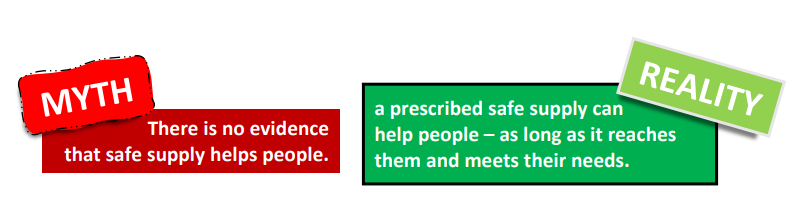
Before that was a class action lawsuit against safe supply by the parents of two teens who died from… NOT safe supply. Kamilah Sword and Amelie North died after taking cocaine and MDMA but their families allege they were addicted to diverted hydromorphone, or dillies. Since a very tiny amount of drug users have access to safe supply (.02%) it will be very hard for these families to prove that it was from this program. It’s much more likely that this was just regular prescription hydromorphone, something that has been diverted since I was a teenager. The B.C. Coroners Service has not found evidence that hydromorphone is causing an increase in overdose deaths or is leading to an increase in addiction among youth.
At the time of this writing, Conservatives are again exploiting the death of a child for political points, this time a 13 year-old who died at a homeless camp. The child began taking MDMA at age 12, which really brings up a lot more questions than answers. According to the parents, they tried to get her help but were unsuccessful so they, uh, kicked her out of the house. Now they are advocating for involuntary care. There is ample evidence that involuntary care doesn’t work but it also raises ethical concerns, who decides what “addiction” is? Will people avoid getting help for fear of incarceration? What happens when they leave involuntary care? While Eby has also touted this idea, Rustad has said he will use the notwithstanding clause to essentially round up people in the streets.
In Ontario, this rhetoric is also having a disastrous effect. The Ford government recently closed 10 overdose prevention sites (while simultaneously allowing liquor in 7-11s). This will undoubtedly lead to more overdoses deaths, and more people using in the streets. There will be blood on the hands of people like Julian Somers, Zivo, Fran Yanoor, and Elenore Sturko.
While myths about safe supply and harm reduction persist, what gets missed in the conversation is all the intangibles. Harm reduction is about so much more than supplies- it’s about community, connection, and resources. Sarah Blyth of Overdose Prevention Society recently posted a video of an OPS that shatters the narrative that our cities are crime infested hellholes. They hate this kind of mutual aid because they can’t profit from it. They can’t use it to scare suburban boomers for clicks and crowdfunding. But most importantly they hate it because people like Sarah are keeping people alive.
But at least some journalists are doing their jobs. While nobody challenged Pierre Pollievre’s lie that Trudeau wants to legalize crack, Penny Daflos deconstructed the BC Conservatives attack ad. Dustin Godfrey has also done some excellent work, debunking Aaron Gunn’s Vancouver is Dying and Port Coquitlam mayor Brad West’s stream of misinformation. West has also joined the latest chorus calling for Riverview to reopen (even though it’s currently open). Again, Penny Daflos breaks down a few of those myths:
There’s a common misperception(opens in a new tab) that since Riverview Hospital’s formal closure, few people are institutionalized due to mental illness. But the advocacy group Health Justice says in B.C. “we detain and involuntarily treat far more people now than we ever did at the height of Riverview’s institutional population.”
But make no mistake: the status quo isn’t working. The status quo being criminalization, incarceration, and neoliberal austerity. By failing to provide a regulated supply of drugs, you are letting organized crime control the trade. By locking users away in prisons, you are condemning addicts to refuse to get help and making the possibility of relapse much greater. And while David Eby hopes to defeat the Conservatives by implementing their demands before the election, many on the left continue to be politically isolated. By letting the Conservatives control the narrative, they are condemning our friends and neighbours to death.